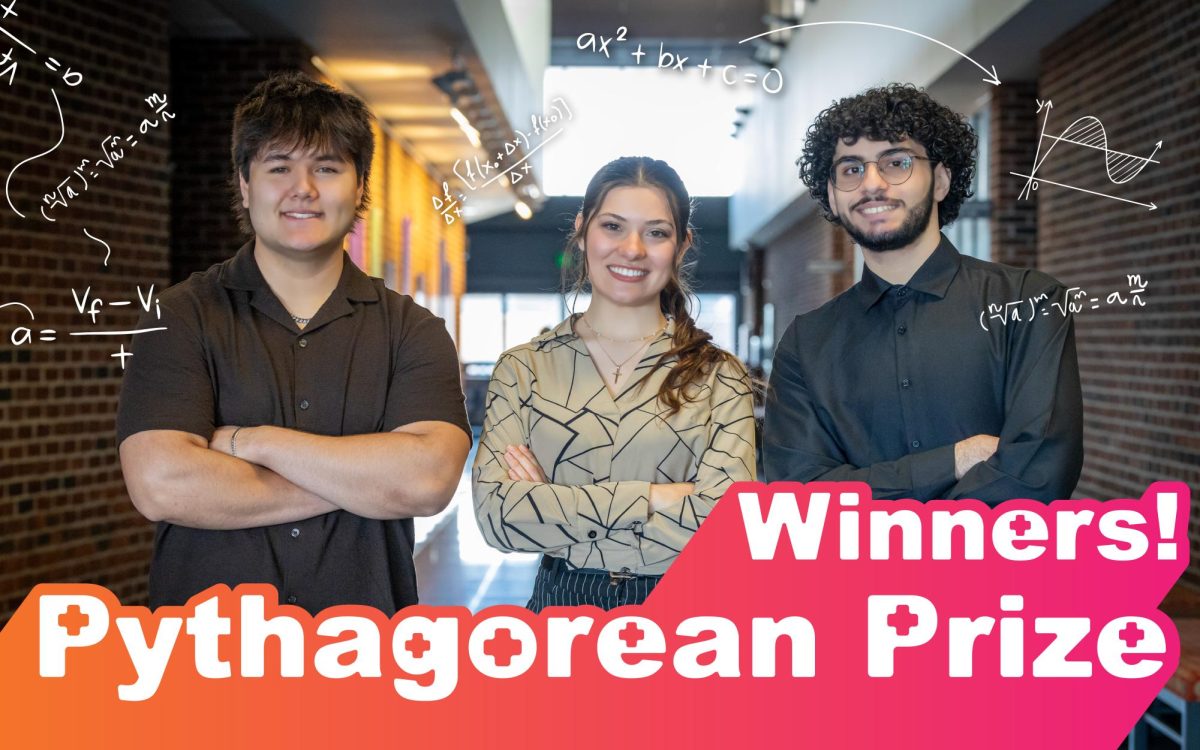
For most students, math is just a requirement on a transcript. But for the winners of the 2026 Pythagorean Prize, it’s been the key to a total academic turnaround.
On April 17, the Schoolcraft Mathematics Department will hold its 31st Annual Pythagorean Prize ceremony, honoring three scholars who represent the absolute best of our STEM community.
The prize is the department’s highest honor, led by Chairperson and Mathematics professor Lawrence Choraszewski, who was the recipient of the award in 2005.
“It’s still surreal to me,” said Choraszewski. “It feels like a personal calling to lift others up the same way I was supported when I was a student here.”
According to Choraszewski, these aren’t your average students. Beyond having near-perfect math grades, this year’s winners stood out because of their “service-driven” mindset. These are the tutors and leaders who step up when nobody asks them to.
What’s most inspiring about this year’s group is that they aren’t all “natural-born” math geniuses. Two of the winners actually shared stories of struggling with the subject in high school.
First place winner, Sophia Mark, is a familiar face to anyone entering the Learning Center. She’s a Math Tutor, a Lead for the PAL (Peer Assisted Learning) Program and the President of the Math and Physics Club, but her path to the top was a long one. Despite falling in love with the “logic” of math at age five, Mark graduated in the bottom 25% of her high school class with a 1.6 GPA.
She came to Schoolcraft with one goal: to master the subject she loved. After seven math classes (all the way up to Differential Equations) and taking the AMATYC math competition five times, Mark is heading to the University of Michigan in Ann Arbor this fall for Industrial and Operations Engineering.
For Mark, the $3,000 prize is more than just a trophy.
“Just knowing that I’ve been seen and recognized as a student who excels in math… it’s a really big deal,”said Mark.
Second place winner Tobi Lile is proof that math is a tool for building the future. He admitted that he started Calculus 1 with a lot of doubt, feeling like high school hadn’t prepared him for the grind of engineering. Lile didn’t just survive the class; he mastered it, and then founded the A3 Engineering Club, a club where students build actual aerospace projects. The club’s biggest accomplishment was to build a fully electric 5-foot wingspan RC plane, which has executed many successful flights. The project was such a great accomplishment, he shared it with the Board of Trustees, and also presented it at the 2026 STEAM@Schoolcraft conference last month.
“I used math not only in theory, but to build something real,” said Lile. Between studying supersonic jet designs and an internship as Quality Assurance Engineer at Hino Motors Manufacturing U.S.A., Lile has stayed busy. He’s headed to Boeing this summer before transferring to University of Michigan, Ann Arbor for Mechanical Engineering. He plans to join the MASA student rocketry team at U of M, and dreams of working for Boeing after graduation.
The surprises didn’t stop with the top two spots. Third place winner Faisal Alnakhala, an Honors student and PTK officer, had a confession of his own: “Funny enough, I failed high school algebra,” said Alnakhala.
Everything changed at Schoolcraft when he realized he was “flying through” Calculus 1. Now a tutor himself, Alnakhala says helping others has shown him how differently everyone’s brain works – but that the same goal is attainable with enough hard work and dedication. He’s headed to Wayne State for a dual program in Electrical and Computer Engineering.
Supported by local donors and the Schoolcraft Foundation, the Pythagorean Prize is a reminder that the community is willing to bet on STEM students. As Mark put it, it’s about passion. She didn’t come to college just because it was the “next step,” she came to do math. And clearly, that passion has paid off.